The asphalt concrete process is often described simply as mixing asphalt binder with aggregate and then paving the mixture. In practice, however, producing consistent asphalt concrete starts much earlier—with the selection and processing of the aggregate. Because aggregate makes up most of the mixture, its size, shape, cleanliness, strength, and gradation have a major influence on the performance of the finished pavement.
For this reason, an efficient asphalt concrete process should be viewed as a complete chain: raw rock selection, crushing, shaping, screening, stockpiling, moisture control, drying, and finally asphalt mixing. If the aggregate entering the asphalt plant is inconsistent, even a well-operated mixing plant may struggle to produce a stable final mixture.
This guide focuses on the asphalt concrete process, explaining how quarry rock is transformed into properly sized and shaped material suitable for asphalt production.
What Is Asphalt Concrete Made Of?
Asphalt concrete is a composite material consisting primarily of mineral aggregate bound together with asphalt cement. Depending on the mixture design and application, it can also contain mineral filler, modifiers, or other additives.
The main components include:
- Coarse aggregate: Provides structural support and load-bearing capacity.
- Fine aggregate: Fills spaces between larger particles and contributes to mixture stability.
- Mineral filler: Helps control void structure and mixture characteristics.
- Asphalt binder: Coats and binds the aggregate particles.
- Additives: May be used to improve specific performance characteristics.
Aggregate properties influence particle interlock, void structure, binder demand, workability, and resistance to traffic loading.
The Complete Asphalt Concrete Process
From an aggregate-processing perspective, the process can be summarized as:
Raw Rock → Feeding → Primary Crushing → Secondary/Tertiary Crushing → Shaping → Screening → Recirculation → Stockpiling → Washing if Required → Drying → Asphalt Mixing
Not every plant requires all these stages. The appropriate configuration depends on the rock type, required production capacity, final aggregate specifications, and particle-shape requirements.
The objective is not simply to crush rock into smaller pieces. The real goal is to produce consistent aggregate with controlled size distribution, shape, cleanliness, and moisture.
Raw Rock Selection for Asphalt Aggregate
The quality of asphalt aggregate begins at the quarry. Common sources include basalt, granite, limestone, diabase, and other competent rocks. The best material is not necessarily the hardest rock; it must have properties suitable for the intended pavement and applicable specifications.
Before designing a processing plant, operators should evaluate:
- Hardness and abrasion resistance
- Strength and durability
- Water absorption
- Mineral composition
- Clay or weathered material content
- Natural moisture
- Maximum feed size
Rock characteristics also determine equipment selection. Highly abrasive material can increase wear on crusher liners and other components, while softer or highly fractured rock may generate fines more readily. Therefore, laboratory testing and material characterization should come before final equipment selection.
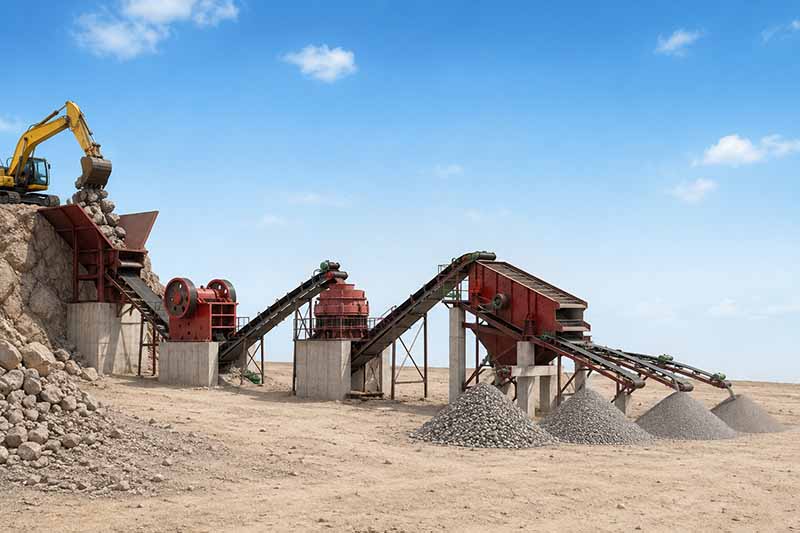
Primary Crushing: Establishing the Processing Foundation
Once suitable quarry rock has been selected, the material is fed into the primary crushing stage. The purpose is to reduce large run-of-quarry material into a manageable size for subsequent processing.
- Jaw crushers are commonly used for primary reduction because they can handle large feed sizes and provide reliable size reduction. A vibrating feeder is normally used to regulate material entering the crusher and maintain a stable feed rate.
- A practical recommendation is to avoid designing the primary crusher solely around its maximum theoretical capacity. The entire circuit—including secondary crushers, screens, conveyors, and stockpiles—must be balanced. The primary crusher should not produce more material than the downstream equipment can handle.
Secondary and Tertiary Crushing
After primary crushing, the material normally enters secondary or tertiary crushing to achieve the required aggregate sizes and shape.
Cone crushers are widely used for hard and abrasive rock, while impact crushers can provide useful particle-shaping characteristics for appropriate materials. The choice should consider:
- Rock hardness and abrasiveness
- Required reduction ratio
- Final product size
- Desired particle shape
- Capacity
- Wear-part consumption
- Fines generation
For asphalt aggregate, size reduction alone is not enough. Particle shape can be equally important.
Particle Shaping With VSI
A vertical shaft impact crusher (VSI) can be incorporated when improved particle shape or manufactured sand quality is required. Its high-speed impact action can help produce more cubical particles and improve the shape of fine aggregate.
However, a VSI should not automatically be included in every plant. Its necessity depends on the raw material, existing crusher products, final specifications, and required sand quantity. A properly designed two-stage circuit may already produce acceptable material for some applications.
Screening and Aggregate Classification
Crushing produces a mixture of particle sizes, so screening is essential for separating the material into controlled fractions. Vibrating screens separate the crushed material according to specified sizes.
A well-designed screening system helps maintain stable gradation and prevents oversized material from reaching the asphalt plant.
Important screening considerations include:
- Screen opening and deck arrangement
- Feed distribution
- Screening efficiency
- Material moisture
- Screen wear
- Required finished-product sizes
For example, an asphalt aggregate plant may produce several separate fractions such as coarse aggregate, intermediate aggregate, and manufactured sand. The exact sizes should be determined by the asphalt mix design rather than selected simply because they are common commercial products.
Washing, Fines Control, and Stockpiling
Not every asphalt aggregate requires washing. Washing becomes useful when the raw material contains excessive clay, mud, or undesirable fine contamination. Depending on the material, washing and classification may involve scrubbers, sand washing equipment, hydrocyclones, or dewatering screens.
- The objective is to produce cleaner aggregate without creating unnecessary water consumption and processing costs.
- Stockpiling is another frequently underestimated stage. Even correctly processed aggregate can become inconsistent if different sizes become mixed, the stockpile segregates, or water accumulates.
Good stockpile management should include:
- Separate storage of different aggregate fractions
- Proper drainage
- Prevention of cross-contamination
- Controlled loading and reclaiming
- Monitoring of moisture variation
Aggregate Gradation and Quality Control
Gradation is one of the most important characteristics of asphalt aggregate. It describes how particles are distributed across different sizes and directly influences packing, voids, binder requirements, and mixture workability.
The crushing and screening circuit therefore needs to be designed around the target gradation.
A useful control relationship is:
Crusher settings → Particle-size distribution → Screening → Recirculation → Final aggregate gradation
Regular sieve analysis can reveal whether the plant is producing excessive fines, insufficient intermediate particles, or too much oversize material. If gradation continually changes, the solution may be found in the quarry feed, crusher settings, screen condition, or stockpile management—not necessarily at the asphalt mixing plant.
Connecting Aggregate Processing to Asphalt Mixing
Once aggregate has been crushed, screened, and stockpiled, it is transferred to the asphalt plant, where the required fractions are proportioned, dried, heated, and mixed with asphalt binder.
The aggregate must arrive at the mixing plant with reasonably consistent:
- Size distribution
- Particle shape
- Cleanliness
- Moisture
- Supply rate
Drying is particularly important because excessive moisture increases energy consumption and can interfere with temperature control and asphalt coating.
This is why aggregate processing should be considered an integral part of asphalt production rather than a separate quarry operation.
How to Design an Asphalt Aggregate Processing Plant?
There is no universal crushing configuration suitable for every asphalt project. A practical design should consider the required finished-product specifications.
Consider the following factors:
- Raw material: hardness, abrasiveness, moisture, clay content
- Capacity: required tons per hour
- Products: number and sizes of aggregate fractions
- Particle shape: whether additional shaping is necessary
- Fines: whether washing or classification is required
- Moisture: stockpile drainage and drying requirements
- Future demand: potential capacity expansion
A typical hard-rock configuration may be:
Vibrating Feeder → Jaw Crusher → Cone Crusher → Vibrating Screen
Where additional shaping is required, a VSI may be introduced before final screening.
The best configuration is the one that reliably and economically meets the required aggregate specifications.
Common Asphalt Aggregate Processing Problems
Several problems can reduce the consistency of aggregate supplied to an asphalt plant:
- Excessive fines: May result from excessive crushing, unsuitable settings, or highly friable rock.
- Poor particle shape: May indicate unsuitable crushing stages or inadequate shaping.
- Unstable gradation: Can result from inconsistent feed, worn screen media, or incorrect crusher settings.
- High moisture: Often relates to stockpile drainage, weather, or washing processes.
- Low production: May originate from a bottleneck in feeding, crushing, screening, or recirculation.
The most effective troubleshooting approach is to identify where the material first deviates from specification rather than simply increasing the capacity of the final-stage equipment.
Conclusion
The asphalt concrete process begins with aggregate production, not asphalt mixing. From selecting suitable quarry rock to controlling crushing, particle shape, screening, gradation, stockpiling, moisture, and drying, every stage contributes to the quality of the final asphalt mixture.
A reliable process follows a simple principle:
Test the raw material → Define the required aggregate → Design the crushing circuit → Control shape and gradation → Manage stockpiles and moisture → Verify quality → Feed the asphalt plant consistently.
For producers planning a new asphalt aggregate line, the most important first step is therefore not choosing a crusher. It is understanding the raw material and final aggregate requirements.
Eastman is a professional mining equipment manufacturer with 38 years of rich experience in the mining construction industry. We can also provide lab equipment. Welcome to consult our professional team to get factory prices. According to your situation and product requirements, we will design a complete sand-crushing production line flow chart and provide an accurate quotation.


