The global construction and demolition waste recycling market is projected to reach 29.3 billion by 2030, growing at a steady CAGR of nearly 5%. Yet for plant operators and investors, the single most consequential decision—the one that determines whether a recycling facility becomes a profitable circular economy asset or a costly bottleneck—is equipment configuration. Most guides offer generic lists of crushers and screens. This guide goes further. It consolidates the core principles of mobile versus stationary setups, dissects the critical crushing and separation stages, and introduces the often-overlooked dimensions of intelligent sorting integration and financial sustainability modeling that separate a viable plant from a failed one.
Why Equipment Configuration Determines Your Plant
Construction waste is not a uniform feedstock. It is a heterogeneous mixture of concrete rubble, brick, timber, plastic, rebar, and soil. The equipment train you design must handle this variability without constant downtime. A misconfigured line causes excessive wear, poor aggregate quality, and ultimately a product no one will buy.
The market context makes this urgent. Asia Pacific already leads demand, with China’s construction waste management market alone projected at USD 16.67 billion in 2026. Meanwhile, the European Union is pushing aggressive circular economy targets, and recycled aggregates can now replace up to 20% of natural aggregates in structural concrete without loss of mechanical properties. The technical feasibility exists. The question is whether your equipment can produce consistently specification-grade material.
The Foundational Decision: Mobile, Portable, or Stationary?
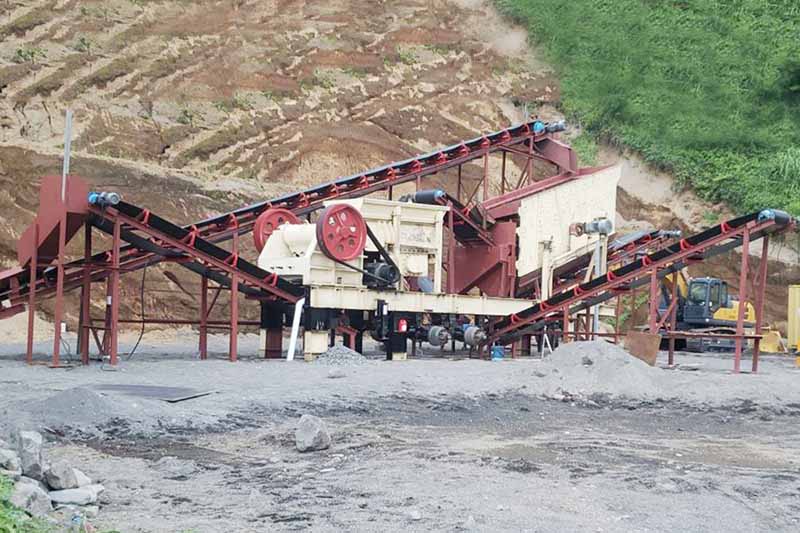
Before selecting individual machines, you must resolve plant mobility. This choice dictates capital expenditure, permitting complexity, and long-term operational flexibility.
Mobile Track-Mounted Systems: Flexibility for Dispersed Sites
Track-mounted crushers and screens are the tool of choice when demolition sites are scattered across a region. They move with the job, eliminating the cost and emissions of trucking raw rubble to a central facility.
- Key advantage: Fast setup and on-site processing reduce transport logistics. Modern units like compact jaw crushers can handle capacities under 200 metric tons per hour while remaining maneuverable on tight demolition sites.
- Best for: Urban demolition projects with limited space, short-term contracts, and situations where the recycled product can be reused directly on-site (e.g., as road base).
- Critical specification: Look for oil-electric dual drive options. These allow operators to switch between diesel power for mobility and grid electricity for lower-cost, lower-emission operation when the unit stays in one place for extended periods.
Portable Wheel-Mounted Plants: The Middle Ground
- Wheel-mounted configurations offer a compromise: easier transport than stationary plants, but higher throughput and better permitting prospects than track units.
- Operational profile: These plants are ideal for production sites that relocate every 1 to 2 years. They typically require a standard truck tractor for relocation rather than a low-boy trailer, simplifying logistics.
- Permitting edge: Because they are non-permanent installations, wheel-mounted plants often face a smoother regulatory path than fixed facilities, which can be a decisive factor in jurisdictions with strict zoning for industrial processing.
Stationary Plants: Maximum Throughput for Centralized Hubs
When construction waste is concentrated—either from a single large demolition project or a steady stream of collection trucks—stationary plants deliver the lowest cost per ton.
- Scale: Fixed plants can be designed for 200 to 500 tons per hour or higher, with custom configurations for specific waste streams.
- Trade-off: High upfront civil works and a fixed location mean you need guaranteed feedstock volume for years, not months.
The Crushing Circuit: Matching Crusher Type to Feed Material
The heart of any recycling plant is the crushing circuit. Using the wrong crusher for the feed material is the fastest route to excessive wear costs and poor product shape.
Primary Crushing: Jaw Crushers for Unpredictable Rubble
- Jaw crushers are the workhorse of primary construction waste reduction. Their compression action tolerates large feed sizes and the occasional unreinforced concrete block that would stall an impactor.
- When to choose jaw: Feed material is highly variable, contains large lumps, or is heavily reinforced with rebar.
- Configuration note: A vibrating grizzly feeder ahead of the jaw is essential. It scalps out fines and soil before they enter the crushing chamber, reducing unnecessary wear and improving overall throughput.
Secondary Crushing: Impact Crushers for Shape and Reduction Ratio
After primary reduction, an impact crusher refines the material into a saleable aggregate. The high-speed rotor and blow bars produce a more cubical product with fewer flaky particles than a cone crusher.
- The “two-cavity” advantage: Modern impact crushers with Austrian-style two-cavity designs allow for a larger feed opening and adjustable output, making them versatile for both concrete and mixed demolition debris.
- Wear part economics: Impact crushers have higher wear costs per ton than jaw crushers, but improved product quality and a higher reduction ratio often justify the expense when producing specification aggregates for concrete or asphalt.
The Finishing Touch: Vertical Shaft Impactors for Sand and Shaping
If your business model includes producing manufactured sand or a premium-shaped aggregate for ready-mix concrete, a VSI is non-negotiable. Its “rock-on-rock” crushing action reduces wear costs and improves particle shape.
Screening and Separation: Where Product Value Is Won or Lost
Crushing gets the headlines, but screening and separation determine whether your output is a low-value fill material or a high-value construction aggregate.
Effective Screening: Beyond Simple Sizing
Heavy-duty scalping: Before crushing, a robust scalper removes dirt and fines. This is especially critical when processing demolition waste.
Grading screens: Multi-deck circular vibrating screens classify the crushed material into precise size fractions. For construction waste, screen media selection matters enormously.
The Critical Role of Air Classification and Magnetic Separation
Construction waste is never just concrete. It contains wood, plastic, paper, and ferrous metals. Removing these contaminants is the difference between a product that meets aggregate standards and one that is rejected.
- Air separators (wind sifters): Placed at the front end or after crushing, these units use controlled airflow to lift light materials (wood, foam, plastic film) out of the heavy aggregate stream. Modern horizontal air classifiers can achieve purity of 98% for light contaminants.
- Overband and self-unloading magnets: Rebar is the most valuable contaminant to recover and the most damaging to crushers if left in the feed. A self-unloading magnet positioned over the discharge conveyor continuously removes ferrous metal, protecting downstream equipment and generating scrap revenue.
Predictive Maintenance and Process Control
Data-driven technologies are reshaping plant operations. Sensors on crusher bearings, conveyor motors, and screen boxes feed into systems that predict failures before they cause unplanned stoppages. For a plant processing abrasive construction waste, where wear is relentless, predictive maintenance directly protects the bottom line.
Beyond the Equipment: The Financial and Operational Framework
An equipment configuration guide that stops at the machinery specification is incomplete. The most sophisticated crushing train will fail if the business model behind it is unsound.
Feedstock Security and Product Offtake
Before ordering a single conveyor, secure two things: a guaranteed waste stream and a guaranteed buyer for the output.
- Feedstock: A plant sized for 200 t/h needs a reliable pipeline of demolition contracts or municipal collection agreements. Relying on spot market rubble leads to feast-or-famine utilization.
- Offtake: Recycled aggregates compete with virgin quarry products on price and consistency. Identifying buyers—road contractors, ready-mix producers, or brick manufacturers—before commissioning is essential.
The Policy Tailwind and Its Limits
Government support is a major growth driver. Strict environmental regulations in China and the EU are pushing contractors away from landfill. However, policy support does not guarantee profitability. A review of financial sustainability for C&D recycling plants concluded that long-term profitability requires integration into circular economy frameworks, not just subsidies. Plants that treat recycling as a commodity production business—focused on cost per ton and product consistency—outperform those that rely on gate fees alone.
Conclusion
The rise of construction waste recycling is not a temporary trend. It is a structural shift driven by resource scarcity, regulatory pressure, and the proven technical viability of recycled aggregates.
Start with the market: What aggregate specification can you sell locally? Then select the crushing and screening circuit that reliably meets that specification with the lowest wear cost per ton. Add the separation and intelligence layers that protect product quality. Finally, stress-test the financial model against realistic utilization rates, not optimistic projections. A plant configured with this discipline will not just process waste. It will manufacture value.
Eastman is a professional mining equipment manufacturer with 38 years of rich experience in the mining construction industry. We can also provide lab equipment. Welcome to consult our professional team to get factory prices. According to your situation and product requirements, we will design a complete sand-crushing production line flow chart and provide an accurate quotation.


