Wet and sticky materials can create serious challenges in crushing plants, particularly when processing clay-rich ores, damp gravel, and aggregates containing excessive fines. When moisture combines with fine particles, materials stick to equipment surfaces, block screen openings, and build up in hoppers and at conveyor transfer points. These problems reduce production efficiency, increase maintenance requirements, and cause unexpected downtime.
Understanding how to process wet, sticky materials in a crusher plant requires more than choosing a powerful crusher. The key is to develop a processing strategy that considers material properties, feed preparation, crushing equipment, screening efficiency, and material handling as one integrated system. With the right combination of equipment and operating practices, operators can maintain more consistent production.
1. What Is the Total Cost of Ownership of Crushing Equipment?
Moisture affects materials in different ways. Relatively clean, damp gravel may remain easy to handle, while clay-rich material can become cohesive and difficult to move. Fine particles may adhere to coarse rocks, form agglomerates, or stick to equipment surfaces, restricting material flow through the plant.
The main problems typically occur at several points in the processing circuit:
- Vibrating Feeders and hoppers: Sticky material may bridge or accumulate, interrupting the feed supply.
- Stone Crushers: Wet fines can build up in the crushing chamber or restrict discharge.
- Vibrating screens: Blinding and pegging reduce the effective open area available for screening.
- Conveyors and chutes: Material carryback and buildup can restrict transfer points.
- Downstream equipment: Ineffective screening can increase recirculating loads and reduce overall plant capacity.
First identify whether the issue is moisture, clay content, excessive fines, equipment design, or operating conditions. Treating every blockage as a crusher problem can lead to unnecessary equipment modifications.
2. Evaluate the Material Before Choosing a Processing Method
A reliable solution starts with understanding the feed material. Moisture content alone cannot predict whether a material will flow freely or cause persistent blockages. Clay mineralogy, particle-size distribution, and the proportion of fine particles can be equally important.
Before changing the crushing circuit, operators should evaluate:
- Moisture content: Determine how much water the material contains and how it changes after rainfall or stockpile storage.
- Clay and fines content: Establish whether sticky fines are concentrated in a particular size fraction.
- Feed-size distribution: Identify the proportions of coarse rock, intermediate particles, and fines.
- Material behavior: Observe whether the feed drains freely, forms cohesive lumps, or adheres to equipment surfaces.
- Product requirements: Confirm the target particle sizes and whether fines must be retained, removed, or processed separately.
Representative sampling and basic laboratory testing can help determine whether the plant needs simple feed preparation or a more extensive washing system.
A clay-contaminated deposit may require scrubbing and washing because the sticky material remains attached to the coarse particles.
3. Choose the Right Processing Route
No single processing method for every wet-material application. The best route depends on the feed characteristics, production target, water availability, and existing plant configuration.
Dry Scalping Before Crushing
Scalping removes selected material before it enters the primary crusher. A suitable grizzly or screening system can separate fines and smaller particles that do not require primary crushing.
This approach can reduce the sticky material entering the crusher, stabilize the feed, and lower the load on downstream equipment. However, conventional dry screening may become ineffective when the feed is extremely wet, or the fines adhere strongly to the screen media.
Washing and Scrubbing
When clay and adhering fines cause persistent problems, washing or scrubbing may be more effective than dry separation alone.
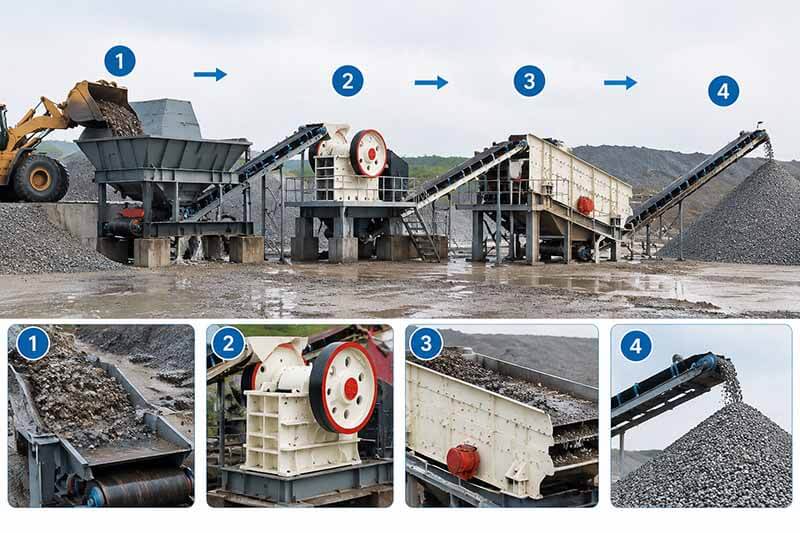
A typical wet-processing arrangement may include:
- Feeding raw material into a suitable feeder.
- Removing selected fines through preliminary screening where practical.
- Washing or scrubbing the material to loosen clay and adhering particles.
- Screening the washed material to separate coarse and fine fractions.
- Sending the coarse fraction to the appropriate crushing stage.
- Managing wash water and separated fines through suitable drainage, classification, or treatment equipment.
- Washing can improve material cleanliness and screening performance, but it also introduces additional requirements for water supply, pumping, dewatering, and wastewater management.
Practical recommendation: Start with the simplest process modification that addresses the identified cause.
4. Optimize Feeding and Crusher Selection
Even suitable crushing equipment can perform poorly when feeding is inconsistent. Wet materials may accumulate in the hopper, discharge unevenly, or overload one side of the crusher.
Improve Feed Control and Material Flow
A stable feed supply helps maintain consistent crushing conditions. Operators should inspect hopper geometry, feeder performance, and transfer chutes for areas where material tends to accumulate.
Useful measures include:
- Using an apron feeder or appropriately designed vibrating feeder for the material and required duty.
- Installing a grizzly feeder when preliminary separation is beneficial.
- Adjusting feeder speed to avoid overfeeding and excessive material accumulation.
- Improving chute geometry and selecting suitable liners where buildup occurs.
- Managing stockpile drainage and limiting unnecessary exposure to rainfall.
Steeper chutes and low-friction liners may improve material movement, but they cannot guarantee reliable flow when the material is highly cohesive. Persistent problems may require a more detailed assessment of the material’s flow properties and the transfer-point design.
Select a Crusher for the Application
Jaw crushers are widely used for primary crushing, while cone crushers and impact crushers serve different secondary or tertiary crushing applications. Specialized roll crushers are suitable for sticky or clay-rich feeds.
The correct selection depends on feed size, rock strength, required product size, material behavior, and discharge conditions. Wet material does not automatically make one crusher type superior to another.
Before replacing a crusher, check whether the real problem originates upstream. Removing problematic fines, improving feed distribution, or correcting a restricted discharge chute may restore performance without requiring a major equipment investment.
5. Improve Screening Efficiency and Prevent Screen Blinding
Screening is often a critical bottleneck in wet-material crushing plants. When sticky fines block the openings, less material can pass through the screen, reducing separation efficiency and potentially increasing the load on downstream crushers.
Selecting suitable screen media and operating conditions can help address this problem.
Choose Appropriate Screen Media
Self-cleaning screen media may help release particles that would otherwise remain lodged in the openings. Wire cloth, polyurethane panels, and specialized flexible media have different characteristics.
The selection should consider:
- Material moisture and clay content.
- Required separation size.
- Screen-media wear life.
- Available open area.
- Maintenance and replacement costs.
- Optimize Screen Operation
Feed distribution, material-bed depth, vibration characteristics, and screen inclination all influence performance. An uneven or excessively deep material bed can reduce the particles reach the screen openings.
Operators should monitor screen performance before changing operating settings. Increasing vibration speed or changing the screen angle does not always improve separation; adjustments must remain within the manufacturer’s recommended operating limits.
If dry screening remains unreliable, wet screening is a good option. Water sprays can help wash fine particles through suitable screen openings, although the additional water must be managed effectively.
6. Prevent Material Buildup on Conveyors and Transfer Points
Material carryback occurs when wet fines remain attached to a conveyor belt after discharge. Over time, the accumulated material can build up around pulleys, interfere with belt tracking, and increase cleaning requirements.
Primary and secondary belt cleaners help remove adhering material. Inspect transfer chutes for restricted passages and recurring buildup.
A preventive-maintenance program should include:
- Checking belt cleaners and scraper condition.
- Inspecting pulleys and transfer points for accumulated material.
- Monitoring belt tracking and abnormal wear.
- Removing material buildup using approved safety procedures.
- Recording recurring blockages to identify their underlying causes.
Any manual blockage-clearing or cleaning work must follow the site’s isolation and lockout/tagout procedures. Never clean equipment while hazardous movement or stored material remains uncontrolled.
7. Monitor Performance and Control Operating Costs
Evaluate equipment modifications using measurable results rather than visual impressions alone.
Useful performance indicators include:
- Saleable-product throughput in tonnes per hour.
- Unplanned downtime caused by blockages.
- Screen-cleaning frequency and labor requirements.
- Product-size distribution and off-specification production.
- Energy and water consumption per tonne.
- Maintenance and wear-part costs.
Record these indicators before and after a modification, comparing similar feed and operating conditions whenever possible.
The economic impact of downtime can be estimated using:
Lost production = Expected saleable production rate × Unplanned downtime hours
To evaluate an investment, also consider installation costs, additional operating expenses, and the financial benefit of any recovered production. This helps determine whether a simple modification, improved maintenance, or a more extensive processing upgrade offers the best overall value.
Conclusion
Learning how to process wet and sticky materials in a crusher plant starts with understanding the feed rather than changing the crusher. Moisture, clay content, particle-size distribution, and material flow all influence the most appropriate processing strategy.
By combining suitable feed preparation, effective crushing, optimized screening, reliable conveyor cleaning, and preventive maintenance, operators can reduce blockages and improve production consistency. When conventional methods are insufficient, washing, scrubbing, and separate fines treatment provide a more effective solution.
The most reliable approach is to match the complete crushing circuit to the material being processed. Testing the feed, identifying bottlenecks, and measuring the results of each improvement can help plant owners make better equipment decisions and maintain stable production under changing operating conditions.
Eastman is a professional mining equipment manufacturer with 38 years of rich experience in the mining construction industry. We can also provide lab equipment. Welcome to consult our professional team to get factory prices. According to your situation and product requirements, we will design a complete sand-crushing production line flow chart and provide an accurate quotation.


