A crushing and screening plant must operate as a coordinated system to achieve consistent production, maintain aggregate quality, and control operating costs. However, even when individual machines perform well, the plant may struggle to reach production targets. Uneven feeding, inadequate screening capacity, excessive circulating load, material blockages, and poorly matched equipment can all restrict throughput.
Preventing bottlenecks in a crushing and screening plant starts with understanding how material moves through the entire circuit. Instead of increasing one machine’s capacity without investigating the underlying problem, operators should identify the actual production constraint and determine how it affects upstream and downstream equipment.
A systematic approach combines performance monitoring, equipment optimization, preventive maintenance, and appropriate plant design. By addressing the root causes of production losses, aggregate producers can increase saleable output and reduce downtime.
What Causes Bottlenecks in a Crushing and Screening Plant?
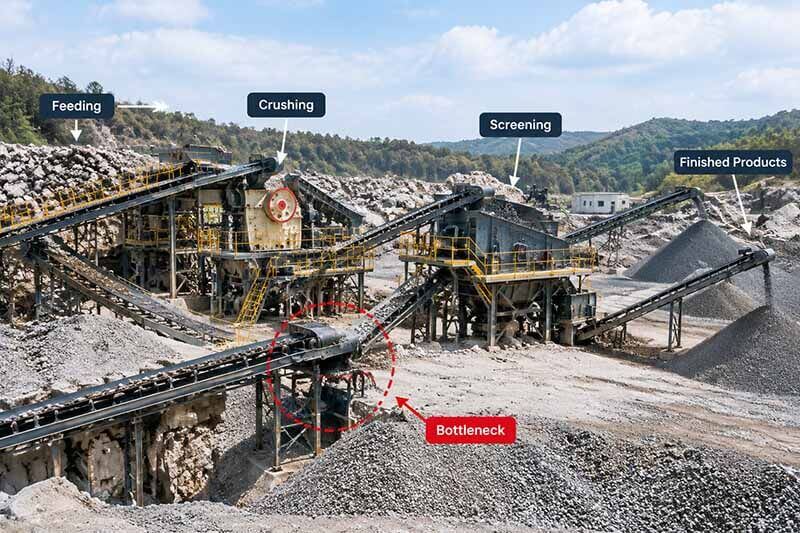
A bottleneck occurs when one stage of a production process restricts the entire system’s output. In a typical aggregate plant, material passes through feeders, primary and secondary crushers, vibrating screens, conveyors, and stockpiles. If one component cannot handle the required material flow, production elsewhere may also be affected.
Common causes include:
- Inconsistent feeding or excessive oversized material.
- Crusher settings that produce unsuitable particle sizes.
- Insufficient screening capacity or screen blinding.
- Conveyor restrictions and material buildup at transfer points.
- Worn components, equipment breakdowns, and frequent stoppages.
- Poor coordination between crushing, screening, and recirculating material.
The key is to distinguish between a machine that is underperforming and one that is simply receiving more material than it can process. The correct solution depends on the actual cause, not just the most visible symptom.
How to Identify the Real Bottleneck?
Measure throughput across the entire circuit.
Before changing equipment settings or investing in upgrades, establish a production baseline. Measure material flow at key points, including crusher feed, screen feed, oversize return, and product discharge.
Throughput can be calculated as:
Throughput = Mass processed ÷ Processing time
Make sure the time basis is consistent. Production measured only while a machine is running will differ from average production over a full shift that includes stoppages.
Operators should also compare actual throughput with equipment specifications under comparable material and operating conditions. A machine operating near its practical limit may not be the root cause if downstream equipment is restricting the overall circuit.
Monitor the right performance indicators.
Several key performance indicators help reveal where production is being lost:
- Throughput: Tons processed per hour or shift.
- Availability: The proportion of scheduled time that equipment is available to operate.
- Circulating load: Material returned for additional crushing relative to the selected circuit-flow basis.
- Screening efficiency: How effectively the screen separates material into the required size fractions.
- Energy intensity: Energy consumed per ton processed.
- Saleable yield: The proportion of feed converted into aggregate that meets product specifications.
Review these indicators together. For example, rising circulating load combined with falling finished-product output may indicate inadequate screening or unsuitable crusher settings.
Prevent Feeding and Material-Flow Restrictions
Maintain consistent feeding
Stable feeding lets stone crushers operate within their intended range. Intermittent feeding can reduce production, while sudden surges may cause overloads and increase wear.
Match feeder capacity to the receiving crusher and distribute material evenly where the equipment design requires it. Inspect the feed for oversized rocks, excessive fines, clay, and other contaminants that could interfere with crushing or screening.
Pre-screening can also improve performance by removing material that does not require further crushing. A suitable grizzly feeder or scalping screen reduces unnecessary crusher loading and may help prevent downstream congestion.
Control material buildup and blockages
Moisture and clay make material adhere to hopper walls, chute surfaces, conveyor belts, and screen decks. These conditions can restrict material flow, reduce screening efficiency, and trigger repeated stoppages.
Practical measures include:
- Inspecting hoppers, chutes, and transfer points for buildup.
- Selecting the right chute angles and liners for the material.
- Maintaining conveyor belt cleaners and controlling carryback.
- Choosing appropriate screen media for wet or sticky feed.
- Reviewing drainage and feed preparation where moisture is a recurring problem.
Blockages cleared only after following the site’s isolation and lockout procedures. Preventive design and routine inspections are safer and more effective than repeatedly responding to the same obstruction.
Optimize Crusher Performance Without Overloading Screens
Adjust crusher settings to match production requirements
Crusher performance depends on feed size, material hardness, chamber design, wear-part condition, and operating settings. The closed-side setting (CSS) influences product size and can affect throughput and the amount of material requiring further processing.
A smaller setting may produce finer material, but it can also increase the load on downstream screens or change the quantity of fines generated. Make adjustments according to the manufacturer’s recommendations and the required product specification.
Operators should regularly check:
- Crusher liner wear and chamber condition.
- Feed distribution and the presence of oversized material.
- Operating settings and power consumption.
- Product gradation and downstream screen loading.
- Reduce unnecessary recirculation
In a closed-circuit plant, oversize material returns to the crusher for additional reduction. This arrangement supports product-size control, but excessive recirculation can consume capacity that would otherwise be available for fresh feed.
Check whether screen separation is effective and whether the crusher is producing the appropriate particle-size distribution. Removing suitable undersize material before further crushing can reduce unnecessary processing, provided the circuit design and product requirements allow it.
The objective is not simply to reduce circulating load at any cost. It is to balance fresh-feed throughput, product quality, and the return load.
Prevent Screening Bottlenecks
Match screen capacity to the material
A vibrating screen‘s effective capacity depends on more than its nominal rating. Feed gradation, moisture, particle shape, bed depth, aperture size, and the required separation all influence performance.
If the screen receives material faster than it can separate it, material may accumulate, separation quality may deteriorate, and oversize return may increase. Check whether the screen has sufficient effective area and material is distributed evenly across the deck.
Select suitable screen media and operating settings
Select screen media according to the material and required size. Wire mesh can provide high open area for suitable applications, while polyurethane or self-cleaning media may help address certain wear or blinding problems.
Inspect for blocked apertures, damaged panels, and uneven material flow. Review screen inclination, vibration parameters, and deck configuration against manufacturer guidance.
A screen upgrade is most effective when you confirm the cause of the restriction. If poor feeding or unsuitable apertures are responsible, replacing the entire screen may not solve the problem.
Balance Equipment Capacity Across the Plant
A crushing plant is only as productive as its overall process flow allows. Increasing primary-crusher capacity may transfer the bottleneck to secondary crushing, screening, conveyors, or stockpile handling.
Evaluate practical operating capacity under the same feed conditions. Confirm that downstream equipment of each stage can accommodate any proposed increase in material flow before implementing an upgrade.
A useful approach is to prioritize corrective actions in stages:
- Correct inconsistent feeding and operating practices.
- Remove material-flow restrictions and restore worn components.
- Optimize crusher settings and screening performance.
- Upgrade individual machines where a verified capacity limitation remains.
- Redesign the circuit if the existing configuration cannot meet production requirements.
This approach avoids unnecessary capital expenditure and reduces the risk of moving the constraint elsewhere in the plant.
Use Monitoring and Preventive Maintenance
Routine inspections and condition monitoring help detect performance deterioration before it causes major production losses. Depending on the equipment and control system, operators can use belt scales, motor-current readings, vibration sensors, temperature measurements, and alarms to identify abnormal operating conditions.
Preventive maintenance should cover crusher liners, screen panels, bearings, lubrication systems, conveyors, drives, and material-transfer components. Follow manufacturer recommendations and adjust based on operating experience and observed wear.
Operators should also maintain records of recurring blockages, overloads, unplanned stops, and corrective actions. These records help distinguish isolated incidents from persistent problems that require engineering changes.
A Practical Method for Removing Existing Bottlenecks
When production falls below target, use a structured troubleshooting process rather than making several adjustments.
- Step 1: Establish a baseline. Record throughput, downtime, product quality, and operating conditions.
- Step 2: Locate the constraint. Compare material flow through each stage and inspect areas where material accumulates or recirculates.
- Step 3: Confirm the root cause. Use measurements and equipment inspections to distinguish capacity limitations from feeding, maintenance, or screening problems.
- Step 4: Implement a targeted change. Prioritize practical adjustments and document the original operating settings.
- Step 5: Verify the result. Repeat measurements under comparable conditions and confirm that product specifications remain satisfied.
- Step 6: Monitor for bottleneck migration. Check downstream and upstream equipment to ensure the improvement increases overall plant output rather than shifting the restriction.
Conclusion
Preventing bottlenecks in a crushing and screening plant requires a whole-plant approach. Consistent feeding, appropriate crusher settings, effective screening, reliable material handling, and preventive maintenance all contribute to stable production.
The most effective improvement begins with accurate measurements and a clear understanding of the root cause. By coordinating equipment capacities, monitoring key performance indicators, and verifying the results of every major change, aggregate producers can increase saleable output, reduce avoidable downtime, and get more value from their existing crushing and screening systems.
Eastman is a professional mining equipment manufacturer with 38 years of rich experience in the mining construction industry. We can also provide lab equipment. Welcome to consult our professional team to get factory prices. According to your situation and product requirements, we will design a complete sand-crushing production line flow chart and provide an accurate quotation.


