Choosing between a mobile crushing station and a fixed production line is one of the most consequential capital decisions a quarry operator, contractor, or construction investor will make. The wrong choice can strand capital in a facility that cannot move when the market shifts, or bleed money through fuel and maintenance on equipment that should have been bolted to a foundation. This guide consolidates the best available data, case evidence, and practical frameworks to help you make the right call with confidence.
The Fundamental Difference Drives Every Decision
Mobile crushing station is, in essence, a factory on wheels that travels to the material. A fixed production line is a permanent industrial facility. Every downstream consideration, whether cost, capacity, permitting, or long-term profitability, flows directly from this single distinction. Understanding it clearly prevents the most common and expensive mistake in equipment selection: comparing sticker prices without comparing total installed cost.
Head-to-Head Comparison: What the Numbers Actually Show
Before evaluating scenarios, investors need a baseline. The following points synthesize data from equipment manufacturers and documented project case studies.
- Capacity range: Mobile units typically process 30 to 800 tons per hour, with combination lines reaching 1,500 tons per hour, while fixed lines range from 50 to 3,000 tons per hour.
- Time to first ton: Mobile stations are productive within 3 to 14 days of arrival, whereas fixed lines require 14 to 24 weeks for foundation work and installation.
- Civil works cost: Mobile units need almost none, requiring only a compacted gravel pad, while fixed installations allocate 15 to 25 percent of total project cost to civil works.
- Equipment price per ton of capacity: Mobile equipment carries a 30 to 70 percent premium over fixed equipment of equivalent capacity.
- Haulage impact: Mobile crushing at the working face cuts transport costs by 50 to 70 percent, while fixed lines add long-term haulage cost as the pit advances.
- Relocation capability: Wheeled units tow at highway speeds and tracked units self-propel, while fixed lines cannot be relocated.
- Long-term operating cost per ton: Mobile plants cost more to run due to fuel consumption and compact maintenance access, while fixed plants benefit from stable grid power and scale effects.
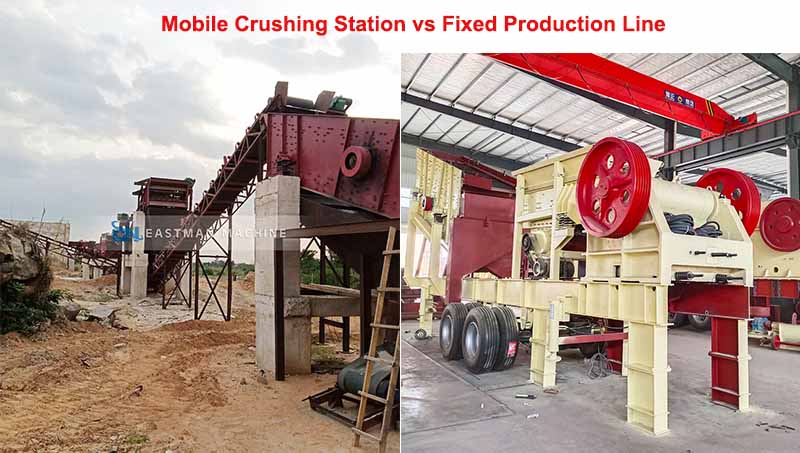
Mobile Crushing Station
The strongest single predictor of mobile suitability is project duration. When a mining permit, road contract, or demolition project has a defined end date within five years, the fixed line’s civil investment cannot be amortized across enough production to justify it. Mobile equipment, by contrast, can be resold or redeployed to the next job without writing off a foundation.
- A documented example makes this concrete. Terratec Basalt in Germany transitioned from stationary to mobile processing and recorded a 25 to 30 percent cost savings, equivalent to roughly one to one and a half euros per metric ton.
- The decisive factor was eliminating half the transport of blasted rock to the old hilltop crusher, because mobile units now process material near the quarry face.
- Multi-site operations present another clear mobile case. Contractors working across scattered pits, highway segments, or demolition sites benefit from a single mobile fleet that follows the work.
- A wheeled unit can legally tow between adjacent sites at highway speeds, and a tracked unit self-propels across rough terrain without a lowboy trailer. The practical decision rule is straightforward: if you will relocate the equipment twice or more per year, the mobile premium pays for itself in mobilization savings alone.
Urban demolition and construction waste recycling represent perhaps the purest mobile use case. The material source, a building being demolished, disappears within weeks. A mobile impact crusher can process rubble on-site into reusable aggregate, avoiding disposal fees and the transport of waste to a distant fixed plant. Mobile units in urban areas do require diligent dust suppression through water sprays and conveyor covers, but they avoid the permanent industrial zoning conflicts that fixed plants can trigger.
Fixed Production Line
A quarry with a twenty-year reserve and consistent demand above 300 tons per hour should almost always go fixed stone production line. The per-ton equipment cost is lower, and the long-term energy and maintenance profile is superior because stationary crushers operate with consistent power draw and easier access for wear-part changes.
- Real-world benchmarks support this. A cases operates a fixed line producing 300 tons per hour with integrated crushing, screening, shaping, and sand making. The facility includes centralized negative-pressure dust collection at every transfer point and automated control, delivering environmental and quality controls that are difficult to replicate on a mobile chassis.
- Strict environmental compliance and product consistency also favor fixed installations. If your operation requires full enclosure, negative-pressure dust collection, and noise attenuation to meet green-mine or urban-adjacent standards, fixed is the only practical answer.
- Mobile plants can meet basic dust limits, with onboard pulse filters achieving levels as low as 10 milligrams per cubic meter in some models.
- Similarly, if the product must meet precise gradation specifications for asphalt chippings or high-grade concrete aggregate, the fixed line’s ability to accommodate multiple screening decks, washing equipment, and fine-tuning without weight or space constraints is decisive.
The Cost Comparison
A common mistake is comparing the sticker price of a mobile jaw crusher against a fixed jaw crusher. The correct comparison is total installed cost to first ton versus total operating cost over the project life.
- For a 100 ton per hour operation, industry estimates place a complete mobile jaw and screen combination at roughly 200,000 to 250,000 US dollars; a fixed line of equivalent capacity runs approximately 150,000 dollars, a mobile premium of 30 to 50 percent.
- However, the fixed line requires foundations, electrical infrastructure, and four to eight weeks of installation labor that the mobile unit avoids.
- The breakeven calculation therefore hinges on three variables: project duration, where mobile wins if the timeline is five years or less; relocation frequency, where mobile wins if the equipment moves at least twice; and haul distance from face to plant, where mobile wins if the fixed haul exceeds roughly two kilometers.
Investors must also budget for the hidden operating cost of mobility. If grid power is unavailable, diesel fuel consumption for a 100-ton-per-hour unit runs 30 to 50 liters per hour, costing two to three times more than equivalent grid electricity. Tracked undercarriages and travel mechanisms introduce wear points that stationary equipment does not have, and maintenance access on a compact chassis is tighter, increasing labor hours for routine service.
The rule of thumb is simple: mobile plants are cheapest to own but most expensive to run, while fixed plants are most expensive to build but cheapest to operate.
The Hybrid Option Most Buyers Overlook
The binary framing of mobile versus fixed misses a practical middle path: semi-mobile or portable wheeled plants that are relocated only occasionally. Collas Kies- und Sandwerke in Germany chose a semi-mobile cone plant rather than a fully stationary installation. The owner explained that a stationary installation would have required suitable foundations and steel construction, whereas the semi-mobile system delivered the best experience while remaining somewhat more flexible.
Semi-mobile units are ideal in three situations. They suit deposits large enough for five to ten years where the working face advances gradually. They work well when grid power is available, eliminating the diesel penalty. They also appeal to operators who want to avoid foundation construction without daily relocation.
Conclusion
Mobile-versus-fixed decision is not about which technology is better. It is about which financial structure matches your project’s reality. A fixed line is a capital-intensive, low-operating-cost asset suited to long-life reserves. A mobile station is a flexible, higher-operating-cost asset suited to short-life or relocatable revenue streams. Investors lose money when they buy mobile equipment for a fifteen-year quarry, pay the premium without earning the mobility benefit, or build a fixed line for a three-year road contract, stranding capital with no resale path. Match the asset to the timeline, and the numbers will work.
Eastman is a professional mining equipment manufacturer with 38 years of rich experience in the mining construction industry. We can also provide lab equipment. Welcome to consult our professional team to get factory prices. According to your situation and product requirements, we will design a complete sand-crushing production line flow chart and provide an accurate quotation.


