Noise is unavoidable in aggregate crushing operations, but excessive noise can create serious challenges for quarry operators, equipment operators, and nearby communities. Jaw crushers, cone crushers, impact crushers, vibrating screens, and belt conveyors all generate noise through mechanical movement, material impact, and structural vibration. When these noise sources are not properly controlled, they can affect worker health, increase environmental compliance risks, and indicate potential equipment problems.
For aggregate producers, reducing noise does not necessarily mean sacrificing production capacity. The key is to identify the main sources and apply appropriate engineering, operational, and maintenance measures. From installing acoustic enclosures to optimizing material feeding and reducing equipment vibration, several practical strategies can make a crushing plant quieter and more efficient.
Identify the Main Sources of Noise in Aggregate Crushing Plants
Before implementing noise-control measures, operators should understand where excessive noise originates. Different machines produce different types of noise, so identifying the source helps determine the most effective solution.
Crushers and Mechanical Components
Crushers are among the major noise sources in aggregate production. Jaw crushers generate noise when rocks are compressed between jaw plates, while cone crushers produce noise through material compression and mechanical movement. Impact crushers generally create significant impact noise because of their high-speed rotors and material collisions.
Common noise sources include:
Material striking jaw plates, blow bars, and crushing chamber liners.
- Worn bearings, gears, and transmission components.
- Loose bolts and poorly secured machine parts.
- Excessive vibration from rotating components or unstable foundations.
- Vibrating Screens and Belt Conveyors
Vibrating screens generate continuous noise through high-frequency vibration and repeated material impact. Steel screen mesh can amplify impact sounds, particularly when processing large or hard aggregates.
Belt conveyors also contribute to plant noise. Worn rollers, damaged bearings, belt misalignment, and rocks falling onto transfer chutes can create additional noise throughout the production circuit.
By understanding these sources, operators can prioritize the equipment and locations.
Measure and Diagnose Noise Levels Before Taking Action
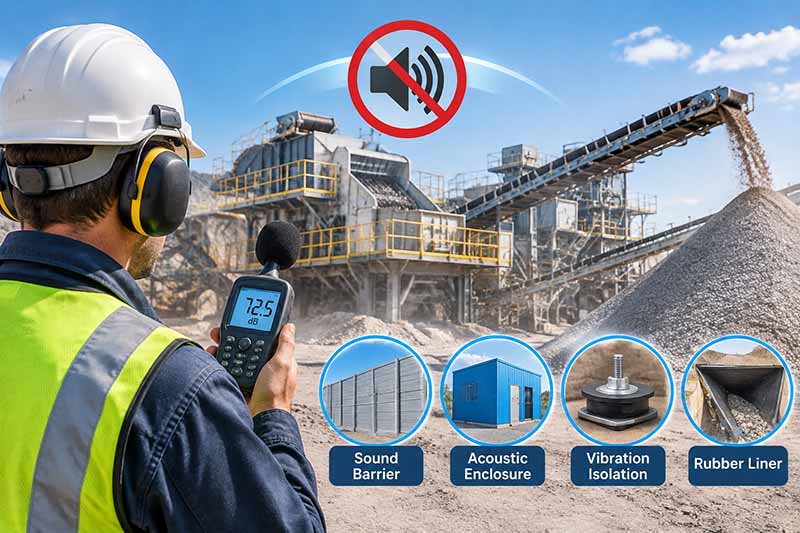
Noise reduction should begin with a baseline assessment rather than relying entirely on operators’ hearing. A professional sound level meter helps measure noise intensity and identify areas requiring improvement.
Measurements should cover several important locations:
- Around primary and secondary crushers.
- Near vibrating screens and conveyor transfer points.
- Inside operator cabins and control rooms.
- At regular monitoring points along plant boundaries.
Noise is commonly expressed in decibels (dB), with dB(A) used for measurements that account for the sensitivity of human hearing. For occupational exposure, the measurement period is also important because a short-term reading does not represent a worker’s full-shift exposure.
Operators should also notice changes in equipment sounds. Grinding, knocking, rattling, or sudden increases in vibration may indicate mechanical problems. These sounds should trigger inspections of bearings, fasteners, lubrication systems, and rotating components.
Practical recommendation: Record noise measurements under comparable operating conditions before and after maintenance or equipment modifications. This makes it easier to determine whether a noise-control measure is actually effective.
Apply Engineering Solutions to Reduce Noise
Engineering controls are generally more effective for long-term noise reduction than relying exclusively on personal protective equipment. The following methods can be applied throughout an aggregate crushing plant.
Install Acoustic Enclosures and Sound Barriers
Acoustic enclosures help prevent noise from spreading beyond noisy machinery. They are particularly useful for stationary crushers, generators, and other equipment operating continuously.
Suitable soundproofing solutions include:
- Acoustic panels around crusher buildings.
- Sound-absorbing materials inside equipment enclosures.
- Noise barriers between crushing areas and worker locations.
- Insulated operator cabins and control rooms.
When designing an enclosure, consider ventilation and maintenance access. Poor ventilation can cause equipment overheating, while insufficient access can make routine inspections difficult. Acoustic ventilation louvers and properly designed access doors help balance noise reduction with equipment performance.
Reduce Equipment Vibration
Mechanical vibration is another important contributor to aggregate plant noise. When vibration travels through machine frames, foundations, and supporting structures, it can create additional structure-borne noise.
Operators can reduce vibration transmission by:
- Installing suitable rubber or spring vibration-isolation mounts.
- Checking foundation stability and equipment anchoring.
- Correcting rotating component imbalance.
- Tightening loose structural connections.
- Replacing damaged damping components.
Isolation systems selection should consider equipment weight, operating frequency, and foundation conditions. Simply adding rubber pads without evaluating the vibration characteristics may not produce the expected results.
Use Rubber and Polyurethane Liners
Rock impact against steel surfaces can generate considerable noise, particularly in feed hoppers, transfer chutes, and vibrating screens. Rubber and polyurethane materials can absorb the impact energy and reduce noise transmission.
Different materials offer different advantages:
- Rubber liners: Suitable for impact-intensive hoppers and transfer chutes because of their flexibility and impact absorption.
- Polyurethane panels: Useful for vibrating screen applications where wear resistance and impact absorption are important.
- UHMWPE liners: Suitable for selected material-handling applications where low friction and impact resistance are beneficial.
Material selection should consider abrasion, impact intensity, temperature, and replacement costs.
Optimize Crushing Operations to Prevent Unnecessary Noise
Equipment operation directly influences noise levels. Even well-maintained machinery can become excessively noisy when material feeding is unstable or operating conditions are unsuitable.
Maintain Consistent Material Feeding
Uneven feeding can cause sudden material impacts, machine overloading, and unstable operation. To improve crushing stability:
- Maintain a consistent feed rate using suitable vibrating feeders.
- Control oversized material entering the crusher.
- Match feed size with the crusher’s specified capacity.
- Avoid sudden surges of material.
- Maintain appropriate crusher settings.
Consistent feeding helps reduce unnecessary mechanical stress and sudden impact noise while supporting stable production.
Maintain Appropriate Equipment Operating Conditions
Operators should follow manufacturer recommendations for crusher settings, rotational speed, lubrication, and operating load. Incorrect settings or excessive loading can increase vibration, accelerate component wear, and produce abnormal noise.
Conveyor systems should also be inspected regularly. Proper belt alignment, healthy rollers, and suitable transfer chute designs help reduce noise generated during material transportation.
Establish Regular Equipment Maintenance and Noise Monitoring
Noise reduction is not a one-time improvement. As equipment wears, bearings deteriorate, liners become damaged, and vibration-isolation components lose effectiveness. Regular maintenance helps prevent these changes from developing into serious noise problems.
A practical inspection schedule can include:
- Daily: Check for unusual operating sounds, visible vibration, and loose components.
- Weekly: Inspect lubrication conditions, bearings, fasteners, and wear liners.
- Monthly: Review equipment vibration and noise measurements.
- Quarterly: Inspect acoustic barriers, enclosures, and vibration-isolation systems.
Operators should also receive training to recognize abnormal equipment sounds and report problems early.
For long-term management, aggregate plants should maintain records of noise measurements, maintenance activities, equipment problems, and corrective actions. These records help evaluate whether noise-control improvements remain effective.
Common Noise-Control Mistakes to Avoid
Some noise-reduction measures fail because operators address the symptoms rather than the underlying problems.
Common mistakes include:
Installing acoustic enclosures without repairing damaged components: Soundproofing cannot correct worn bearings, loose parts, or mechanical imbalance.
- Ignoring conveyors and transfer points: Crushers are not the only noise sources in an aggregate production line.
- Selecting unsuitable insulation materials: Poor material selection may create overheating, maintenance difficulties, or premature wear.
- Neglecting regular monitoring: Noise levels can increase again as equipment deteriorates or operating conditions change.
A more effective approach is to identify the noise source, correct mechanical problems first, and then introduce suitable engineering controls.
Conclusion
Reducing noise levels in aggregate crushing operations requires a combination of equipment maintenance, vibration control, acoustic protection, and proper operating practices. Identifying the main noise sources is the first step, followed by selecting appropriate solutions for crushers, vibrating screens, conveyors, and material transfer points.
For aggregate producers, the most effective strategy is to control noise at its source whenever possible while maintaining stable production conditions. With regular inspections, suitable soundproofing materials, and continuous noise monitoring, crushing plants can create safer working environments, reduce environmental noise impact, and maintain reliable equipment performance.
Eastman is a professional mining equipment manufacturer with 38 years of rich experience in the mining construction industry. We can also provide lab equipment. Welcome to consult our professional team to get factory prices. According to your situation and product requirements, we will design a complete sand-crushing production line flow chart and provide an accurate quotation.


