Designing a crushing plant for multiple product sizes requires more than selecting crushers with sufficient production capacity. The plant must process raw materials efficiently, separate different particle sizes, and deliver consistent finished products. Whether producing manufactured sand, fine aggregate, medium gravel, or coarse stone, every stage of the production line affects the final product distribution.
A well-designed multi-product crushing plant combines appropriate crushing equipment, properly configured vibrating screens, balanced material flow, and sufficient stockpile capacity. More importantly, the design must consider the proportion of each product required rather than focusing only on total output. This guide explains the key steps, equipment considerations, and practical strategies for designing a crushing plant that produces multiple aggregate sizes.
1. Define Product Requirements Before Designing the Plant
Firstly, identify the finished products. Different construction applications require different aggregate specifications. For example, a plant supplying concrete and road construction projects may need to produce 0–5 mm, 5–10 mm, 10–20 mm, and 20–31.5 mm materials.
Each product should have a defined size range, quality specification, and production target. These requirements determine the number of screening stages, screen openings, and crushing equipment needed.
Before selecting equipment, evaluate the following factors:
- Product sizes: Identify all required finished aggregate fractions.
- Production capacity: Determine the total hourly and daily production targets.
- Product demand: Estimate the percentage of total output required for each size.
- Raw material properties: Evaluate hardness, abrasiveness, moisture, clay content, and maximum feed size.
- Site conditions: Consider installation space, terrain, electricity, and water.
Understanding these requirements prevents equipment mismatches after installation.
2. Develop the Crushing Plant Process Flow
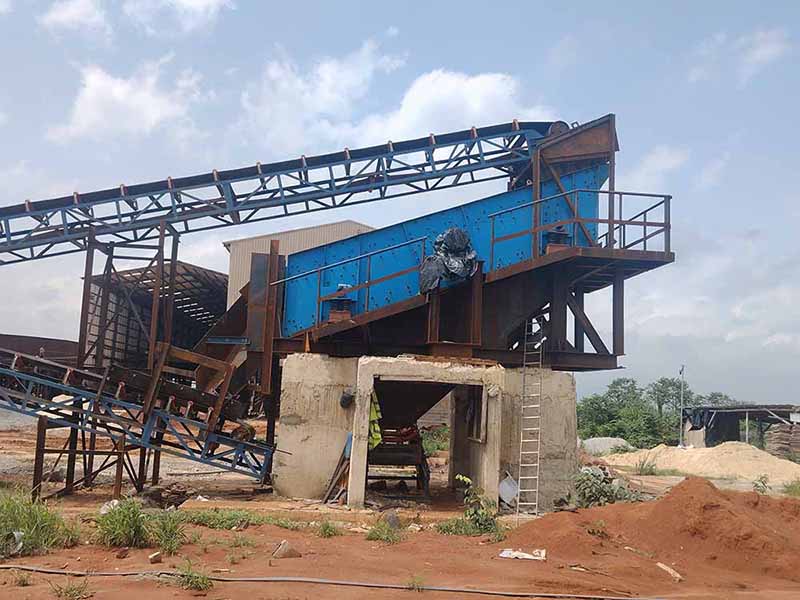
Once the production requirements are clear, develop a process flow that connects crushing, screening, and material handling.
A typical multi-product aggregate plant follows this sequence:
Raw Material → Vibrating Feeder → Primary Crusher → Secondary Crusher → Vibrating Screen → Finished Products
The primary crusher reduces large rocks into manageable material, while secondary and tertiary crushers further reduce particle sizes. Vibrating screens then separate the crushed material into different fractions.
Open-Circuit vs. Closed-Circuit Crushing
Open-circuit crushing allows material to pass through a crusher without returning oversize particles for further reduction. It is relatively simple but may produce less controlled particle sizes.
Closed-circuit crushing uses a vibrating screen to separate finished-size material from oversize particles. Oversize material returns to the crusher for additional reduction.
For multiple-product production, closed-circuit arrangements often help control product gradation and reduce unnecessary crushing of material that already meets the required size.
3. Select the Right Crushing Equipment

Crusher selection needs to consider raw material characteristics, required reduction ratios, and particle-size distribution.
Primary Crushing: Jaw Crushers and Gyratory Crushers
Jaw crushers are commonly used in small and medium-sized aggregate plants because of their simple structure, reliable operation, and ability to handle large feed materials. Gyratory crushers suit high-capacity operations with continuous primary crushing.
Secondary and Tertiary Crushing: Cone vs. Impact Crushers
- Cone crushers suit hard, abrasive materials. They provide controlled size reduction and are commonly used in granite, basalt, and other hard-rock applications.
- Impact crushers suit softer, less abrasive materials. However, wear costs can increase when processing highly abrasive rock.
- For finer products, tertiary crushing equipment, including VSI crushers, may be considered to improve particle shape and produce manufactured sand.
Match Crusher Settings With Product Requirements
Crusher settings will influence discharge size and the amount of fines and oversize material. Operators should consider:
- Closed-side setting (CSS).
- Feed particle-size distribution.
- Crusher reduction ratio.
- Feed consistency and choke-feeding conditions.
- Wear-part condition.
The objective is not simply to maximize crushing capacity. It is to produce material that can be efficiently separated into the required finished sizes.
4. Design the Screening System for Multiple Product Sizes
Screening is one of the most important stages in a multi-product crushing plant because it determines how crushed material is divided into different size fractions.
A multi-deck vibrating screen can separate material into several products. For example, a three-deck screen with appropriately selected openings can produce four fractions:
- Material retained on the top deck.
- Material passing the top deck but retained on the second deck.
- Material passing the second deck but retained on the third deck.
- Material passing through the bottom deck.
The actual product sizes depend on the selected screen apertures and operating conditions.
Select Screen Apertures and Capacity
Select screen openings according to the required product specifications. However, screen capacity is equally important. An undersized screen may cause poor separation, excessive material accumulation, and contamination between finished products.
Important screening factors include:
- Screen surface area and open area.
- Number of decks and aperture dimensions.
- Feed rate and particle-size distribution.
- Material moisture and clay content.
- Screen inclination and vibration characteristics.
- Screen-media wear and maintenance.
For wet or sticky materials, screen blinding can significantly reduce separation efficiency. Appropriate screen media, material preparation, and moisture management help maintain stable operation.
5. Calculate Material Balance and Product Output
A crushing plant may meet the production target but fail to produce the required quantities of individual products. Therefore, include material balance calculations during the design stage.
A basic product output formula is:
Product Output = Total Feed × Product Yield
For example, consider an illustrative 200 TPH crushing plant with the following assumed product distribution:
Finished product | Yield | Output |
0–5 mm | 15% | 30 TPH |
5–10 mm | 25% | 50 TPH |
10–20 mm | 35% | 70 TPH |
20–31.5 mm | 25% | 50 TPH |
Total | 100% | 200 TPH |
These figures are illustrative, not guaranteed production results. Actual yields depend on raw material gradation, crusher settings, screening efficiency, and circuit configuration. Representative sampling and sieve analysis are necessary to establish realistic production estimates.
Control Recirculating Load
In a closed-circuit system, oversize material returns to the crusher. Excessive recirculation increases equipment loading, energy consumption, and wear.
Operators should monitor screen performance, crusher settings, and circulating material.
6. Design Conveyors and Stockpiles for Separate Products
After screening, each finished product needs appropriate transportation and storage. Separate discharge conveyors and dedicated stockpile areas help prevent different aggregate sizes from mixing.
Plant designers should consider:
- Conveyor capacity and routing for each product stream.
- Sufficient stockpile space for different fractions.
- Appropriate conveyor discharge heights.
- Loader and truck access.
- Stockpile segregation and drainage.
- Intermediate storage and surge capacity.
Poor stockpile planning can reduce finished-product quality even when crushing and screening performance is satisfactory. Therefore, material handling is part of the overall production design.
7. Optimize Plant Layout, Energy, and Maintenance
A good crushing plant layout minimizes unnecessary material transportation while providing safe access to equipment.
Whenever practical, use gravity-assisted material flow and reduce excessive conveyor transfer points. Position crushers, screens, and conveyors according to the production sequence, while allowing sufficient space for inspection and wear-part replacement.
Other important considerations include:
- Install dust suppression at crushers and material transfer points.
- Select motors and drives for operating requirements.
- Provide safe maintenance platforms.
- Monitor crusher and screen performance regularly.
- Reserve space for additional equipment or future production changes.
From an engineering perspective, balance equipment capacity across the entire circuit. Increasing crusher capacity alone will not improve production if the vibrating screen or conveyor system becomes the limiting factor.
8. Common Mistakes in Multi-Product Crushing Plant Design
Several design mistakes can reduce production efficiency and finished-product quality:
- Selecting equipment before defining product sizes: This can result in unsuitable crusher settings and screen configurations.
- Undersizing vibrating screens: Insufficient screening capacity causes poor separation and product contamination.
- Ignoring product demand ratios: The plant may produce excessive quantities of some sizes while failing to meet demand for others.
- Poor conveyor and stockpile planning: Different finished products may become mixed during transportation and storage.
- Ignoring future flexibility: A plant without sufficient space or adaptable equipment may require expensive modifications when market requirements change.
Avoiding these problems during the planning stage.
Conclusion
Designing a crushing plant for multiple product sizes requires a coordinated approach to material analysis, crusher selection, screening configuration, material balance, and finished-product handling. Each stage must work together to achieve the required product distribution without creating unnecessary crushing, screening, or transportation bottlenecks.
The most effective design starts with clear product specifications and realistic production targets. By matching equipment capacities, selecting suitable screen configurations, and planning separate material-handling systems, operators can build a flexible crushing plant that delivers consistent aggregate products and supports changing market demand.
Eastman is a professional mining equipment manufacturer with 38 years of rich experience in the mining construction industry. We can also provide lab equipment. Welcome to consult our professional team to get factory prices. According to your situation and product requirements, we will design a complete sand-crushing production line flow chart and provide an accurate quotation.


