In a closed crushing circuit, some material naturally returns to the stone crusher. Oversize from the screening stage is recycled for further crushing until it meets the required product size. This recirculating load is therefore a normal part of closed-circuit operation.
The problem occurs when too much material is circulated. Excessive recirculating load consumes crusher capacity, increases screen and conveyor loading, raises energy and wear costs, and can reduce finished-product output. The key point is reducing recirculating load in a crushing circuit.
What Is Recirculating Load in a Crushing Circuit?
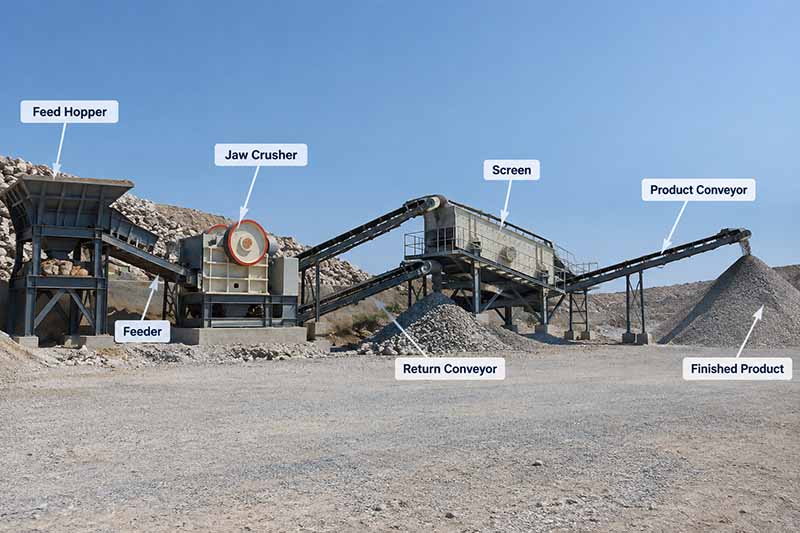
A typical closed circuit consists of a crusher, vibrating screen, feeders, and conveyors. Fresh feed enters the crusher, and the crushed material is sent to the screen. Undersize becomes the finished product, while oversize returns to the crusher.
The material returning to the crusher is called the recirculating load or circulating load. As a result, the crusher’s actual throughput can be significantly higher than the amount of fresh feed entering the plant.
For example, if a circuit receives 100 t/h of fresh feed and 40 t/h returns from the screen, the crusher handles approximately 140 t/h in total.
Is Recirculating Load Always a Problem?
No. Some recirculation is necessary because particles that are too large must be crushed again. The real objective is to reduce unnecessary recirculation, especially by returning correctly sized material.
Operators should therefore ask:
- How much material is returning?
- How much of the return stream is genuinely oversized?
- Is the crusher producing excessive oversize?
- Is the screen failing to separate correctly?
- Has the feed material changed?
These questions provide a better starting point than simply trying to achieve the lowest possible circulating-load percentage.
How to Calculate Recirculating Load?
The basic calculation compares the return stream with the fresh feed:
- Recirculating Load (%) = Return Load ÷ Fresh Feed × 100
- For example, with 100 t/h of fresh feed and 40 t/h of return material:
- Recirculating Load = 40 ÷ 100 × 100% = 40%
The total crusher load is:
- Total Crusher Load = Fresh Feed + Return Load
- Therefore, the crusher is handling 140 t/h even though only 100 t/h is fresh feed.
Screen efficiency also has a major influence. If correctly sized particles remain in the screen oversize stream, they return to the crusher unnecessarily. Improving screening efficiency can therefore reduce recirculation without changing the crusher itself.
What Causes Excessive Recirculating Load?
High recirculating load can originate from the crusher, screen, feed material, or overall circuit.
The Stone Crusher Produces Too Much Oversize
Crusher performance directly affects the material returned from the screen. Important factors include:
- Closed-side setting (CSS)
- Crusher chamber configuration
- Liner wear
- Feed size distribution
- Material hardness and crushability
- Feed distribution
A worn chamber or unsuitable setting can shift the crusher discharge toward a coarser size distribution, increasing the amount of material requiring another crushing pass.
The Vibrating Screen Is Not Separating Efficiently
A crusher may be operating correctly while the screen creates excessive circulation. Common causes include:
- Excessive material bed depth
- Poor feed distribution
- Incorrect screen aperture
- Blinding or pegging
- Damaged screen media
- High moisture or sticky material
- Insufficient screening area
- Feed Characteristics Have Changed
Changes in the raw material can increase recirculation even when equipment settings remain unchanged. Harder rock, larger feed, higher moisture, clay, or changes in feed particle-size distribution can all affect crushing and screening performance.
How to Diagnose Whether the Crusher or Screen Is the Problem?
The most effective approach is to follow the material through the circuit and measure each major stream.
Check the Return Stream
Start by sampling the return belt conveyor and examining its particle-size distribution. If the return contains a large amount of material that already meets the target size, screening is likely contributing to unnecessary recirculation.
If most of the return is genuinely oversized, investigate crusher performance.
Check the Crusher Discharge
Compare crusher discharge with the required product specification. Monitor:
- Crusher CSS
- Discharge particle-size distribution
- Crusher power
- Feed rate
- Liner condition
- Feed characteristics
If the crusher consistently produces excessive oversize, its operating parameters or chamber condition may need attention.
Check Screen Performance
If crusher discharge is acceptable but return load remains high, inspect the screening stage. Check screen media, feed distribution, aperture size, moisture, bed depth, and screening area.
A practical diagnostic sequence is:
High return load → sample return → check crusher discharge → check screen performance → check feed conditions → evaluate circuit balance.
How to Reduce Recirculating Load Without Hurting Product Quality?
Reducing return material is useful when the final product still meets specification.
Optimize Crusher Settings
Reducing CSS can increase the proportion of smaller particles and potentially reduce oversize. However, an excessively tight setting may increase fines, power consumption, and wear.
Crusher settings should therefore be selected according to:
- Required product size
- Feed characteristics
- Crusher type and chamber
- Reduction ratio
- Power availability
- Wear condition
The goal is not the smallest possible CSS, but an efficient operating point that produces the required product.
Improve Screening Efficiency
Screen optimization can reduce unnecessary circulation without increasing crushing work. Practical measures include:
Maintain uniform feed distribution.
Use suitable screen media and aperture sizes.
- Replace damaged panels.
- Prevent excessive bed depth.
- Control blinding and pegging.
- Provide adequate screening area.
Remove Natural Fines Before Crushing
If the feed contains substantial natural fines that are already below the target size, prescreening or scalping can remove them before crushing. This lets the crusher focus its capacity on material that actually needs size reduction.
However, prescreening should be based on the feed characteristics and overall circuit requirements.
How Feed Characteristics Affect Recirculation?
Feed properties can strongly influence closed-circuit performance. Harder material generally requires greater crushing effort, while wet or clay-rich feed can reduce screening efficiency.
Particle shape is also important. Flat or elongated particles may behave differently on a screen than cubical particles of similar nominal size. Consequently, particle size alone does not always explain why material remains in the oversize stream.
Monitor changes in:
- Feed PSD
- Maximum feed size
- Hardness
- Moisture
- Clay content
- Natural fines
- Particle shape
- Abrasiveness
Understanding these changes helps determine whether a problem is equipment-related or caused by changing feed conditions.
How to Optimize the Entire Crushing Circuit
Increasing crusher output can overload the screen, while improving screening can increase conveyor or downstream capacity requirements.
Evaluate the complete circuit, including:
- Primary, secondary, and tertiary crushers
- Vibrating screens
- Vibrating Feeders
- Return conveyors
- Transfer points
- Product conveyors
- Downstream processing equipment
Stage crushing can also reduce unnecessary repeated crushing. Intermediate screening lets correctly sized material bypass further size reduction, while oversize moves to the next crushing stage.
Optimize, Upgrade, or Replace?
Not every high circulating-load problem requires new equipment.
Optimize Existing Equipment
Start with optimization when equipment has unused capacity or operating conditions are poorly controlled. Feed stabilization, crusher adjustment, screen maintenance, and circuit balancing may provide significant improvements.
Upgrade Existing Equipment
Consider upgrades when the basic machine remains suitable but its performance limits production. Possible improvements include wear components, adjustment systems, screening equipment, and monitoring or control systems.
Replace or Redesign the Circuit
Replacement may be justified when equipment is fundamentally undersized, outdated, or unable to meet required capacity and product specifications.
Before major investment, compare:
- Additional production
- Capital cost
- Operating cost
- Energy consumption
- Maintenance
- Wear
- Future capacity requirements
A Practical Procedure to Reduce Recirculating Load
A systematic optimization process can follow six steps:
- Establish a baseline: Record fresh feed, return tonnage, finished product, CSS, power, and product PSD.
- Sample major streams: Check fresh feed, crusher discharge, screen oversize, and final product.
- Identify the cause: Determine whether crushing, screening, feed conditions, or circuit balance is responsible.
- Change one major variable: Avoid making several major adjustments at the same time.
- Measure the result: Compare return load, finished product, PSD, power, and screen performance.
- Verify long-term performance: Confirm the improvement under different feed conditions.
How to Know Whether the Optimization Worked?
The lowest circulating-load percentage is not necessarily the best result. A successful optimization improves the plant performance.
Track:
- Finished-product throughput
- Fresh-feed throughput
- Recirculating load
- Product PSD
- Crusher power consumption
- Screen efficiency
- Wear rate
- Downtime
- Operating stability
For example, opening the crusher setting may reduce return tonnage, but if excessive oversize enters the final product, the circuit has not actually been improved.
Common Mistakes When Reducing Recirculating Load
Avoid these common approaches:
- Simply tightening CSS: May increase fines, energy consumption, and wear.
- Increasing screen aperture without checking product quality: Can allow oversize into the final product.
- Increasing crusher capacity without checking the screen: May transfer the bottleneck downstream.
- Focusing only on return percentage: Lower circulation does not automatically mean higher finished-product output.
- Changing several parameters at once: Makes results difficult to interpret.
- Ignoring feed variability: A solution for one material may not work for another.
Conclusion
Reducing recirculating load in a crushing circuit is not simply reducing the amount of material returning to the crusher. Some recirculation is necessary in a closed circuit. The real objective is to eliminate unnecessary return material while maintaining product quality and maximizing useful throughput.
The most reliable strategy is to measure the circuit, identify whether the crusher or screen is responsible, evaluate feed conditions, and then optimize the complete system.
Ultimately, the best result is not merely a lower circulating-load percentage. It is a crushing circuit that produces the required product at stable throughput, with controlled energy consumption, wear, and unnecessary material handling.
Eastman is a professional mining equipment manufacturer with 38 years of rich experience in the mining construction industry. We can also provide lab equipment. Welcome to consult our professional team to get factory prices. According to your situation and product requirements, we will design a complete sand-crushing production line flow chart and provide an accurate quotation.


